

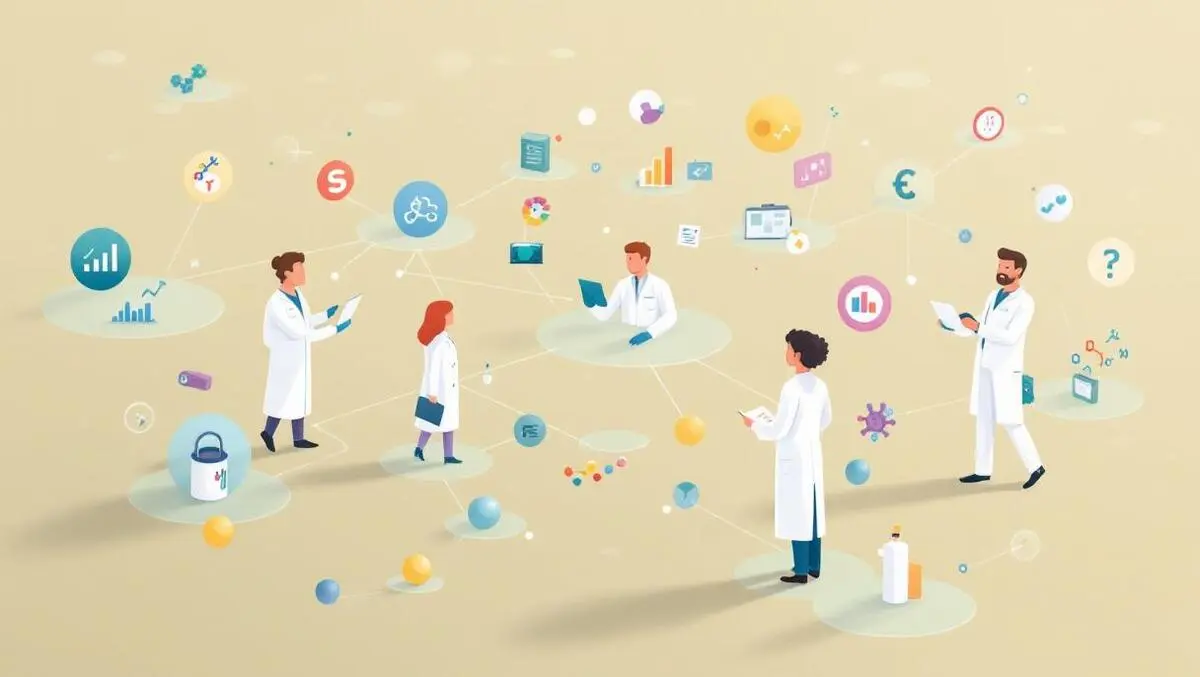
Elix launches world's first federated AI drug discovery platform
Fri, 18th Jul 2025
Elix and the Life Intelligence Consortium (LINC) have announced the commercialisation of an AI drug discovery platform utilising federated learning on data from multiple pharmaceutical companies, marking the first instance of such a deployment globally.
The platform, now available as part of Elix Discovery, has been developed in collaboration with 16 pharmaceutical companies. It features a collection of AI models that have been co-trained using federated learning - a technology that enables collaborative machine learning without the need for participants to share confidential data externally.
Federated learning and pharmacological data
One of the primary challenges in AI-driven drug discovery has long been the limited availability of high-quality, diverse datasets. Individual pharmaceutical companies commonly rely on proprietary data and publicly accessible resources, which often leads to significant data constraints and hinders the development of robust AI models.
To address this, Elix partnered with the Department of Biomedical Data Intelligence at Kyoto University to develop the federated learning library kMoL. This system permits secure collaboration between companies, allowing for the joint training of AI models without compromising sensitive data such as compound structures.
The newly developed suite of models is embedded in Elix Discovery, which has already been implemented by several pharmaceutical companies. There are expectations that more companies will adopt the platform over time, leading to improvements in model accuracy and usability as the dataset grows.
From research to real-world application
This commercialisation effort builds on the achievements of the "Development of a Next-generation Drug Discovery AI through Industry-academia Collaboration" (DAIIA) programme, an initiative launched under the Japan Agency for Medical Research and Development (AMED). The DAIIA project included 17 pharmaceutical firms, research institutes such as RIKEN, Kyoto University, Nagoya University, and approximately 10 IT entities specialising in artificial intelligence.
Following the completion of the DAIIA initiative, Elix and LINC have partnered to ensure the ongoing utilisation and further advancement of the AI models and processes developed during the programme.
Industry and academic perspectives
On the occasion of commercializing the AMED project, I would like to express my heartfelt gratitude to AMED and to all the pharmaceutical companies that have cooperated with us. This commercialization has two points of significance. First, while many government-funded projects fail to reach practical implementation after their funding period ends, this initiative will be utilized by pharmaceutical companies, thereby contributing directly to real-world drug discovery.
Second, multiple pharmaceutical companies will continue to share data across the industry through federated learning, aiming to develop highly accurate AI. In an industry where the pursuit of individual corporate profit often takes precedence, the effort by each of these companies to share data for the benefit of patients and to build and utilize high-performance drug-discovery AI is profoundly meaningful and a source of great pride. I sincerely hope that this project will become a cornerstone for enhancing Japan's drug-discovery capabilities and, ultimately, contribute to the health of patients around the world.
These remarks were offered by Yasushi Okuno, Representative Director of LINC and Professor at Kyoto University, who is also a co-investigator of the AMED DAIIA Project.
Teruki Honma, Team Director at RIKEN and R&D Principal Investigator for the project, addressed the technological and collaborative achievements made possible through the DAIIA initiative.
I am delighted that the AI models for on/off‐target prediction, ADMET prediction, and molecular generation produced by the AMED DAIIA project will now be commercialized by LINC and Elix. DAIIA's predictive AIs were built using chemical structure data provided by pharmaceutical companies, and training on structural data covering more than 1 million compounds and over 10 million data points, is unprecedented on a global scale. This training was made possible by a dedicated system capable of stable federated learning, allowing collaborative model development while preserving confidentiality.
Regarding the generative AI, we plan to extend ChemTS and incorporate advanced functions such as DyRAMO, which enables efficient multi‐objective optimization. This will make it possible to create novel compounds and evaluate their activity profiles with higher accuracy and speed than ever before. Continuous updates are indispensable when leveraging technologies such as federated learning and generative AI. Through this commercialization, I expect the achievements of DAIIA to keep evolving and, delivered as long‐term software for pharmaceutical companies, to greatly contribute to the acceleration and innovation of drug discovery research.
Implications for the pharmaceutical sector
Shinya Yuki, Co-Founder and CEO of Elix, highlighted the importance of overcoming data scarcity through federated learning and the potential industry-wide impact of the commercialised models.
Data scarcity remains one of the biggest challenges in AI drug discovery. By jointly developing federated learning technology, kMoL, with the Department of Biomedical Data Intelligence, Graduate School of Medicine, Kyoto University, we have created a system that enables learning from the data held by 16 pharmaceutical companies while preserving the confidentiality of data such as compound structures. Commercializing the predictive models we have built and deploying them on an AI drug discovery platform is a world‐first initiative.
This accomplishment was only possible through the collaboration of pharmaceutical companies, academia, AMED, LINC, and AI/IT enterprises involved in the project, and represents an important milestone that advances the use of AI in the pharmaceutical industry to a new stage. I believe that this will make Elix Discovery the de‐facto standard of AI drug discovery platforms. This federated learning based initiative is just the starting point for further progress. By encouraging even greater participation and data contributions from pharmaceutical companies, we aim to further expand and strengthen this initiative, enhancing our contribution to the pharmaceutical industry as a whole and ultimately to patients.
With the roll-out of the federated learning-based platform, initial use will centre on the pharmaceutical firms that participated in DAIIA, with plans to extend access to additional companies. As the user base widens, the depth and scope of the data used to train the AI models is expected to grow, supporting improved performance in drug discovery research workflows.