

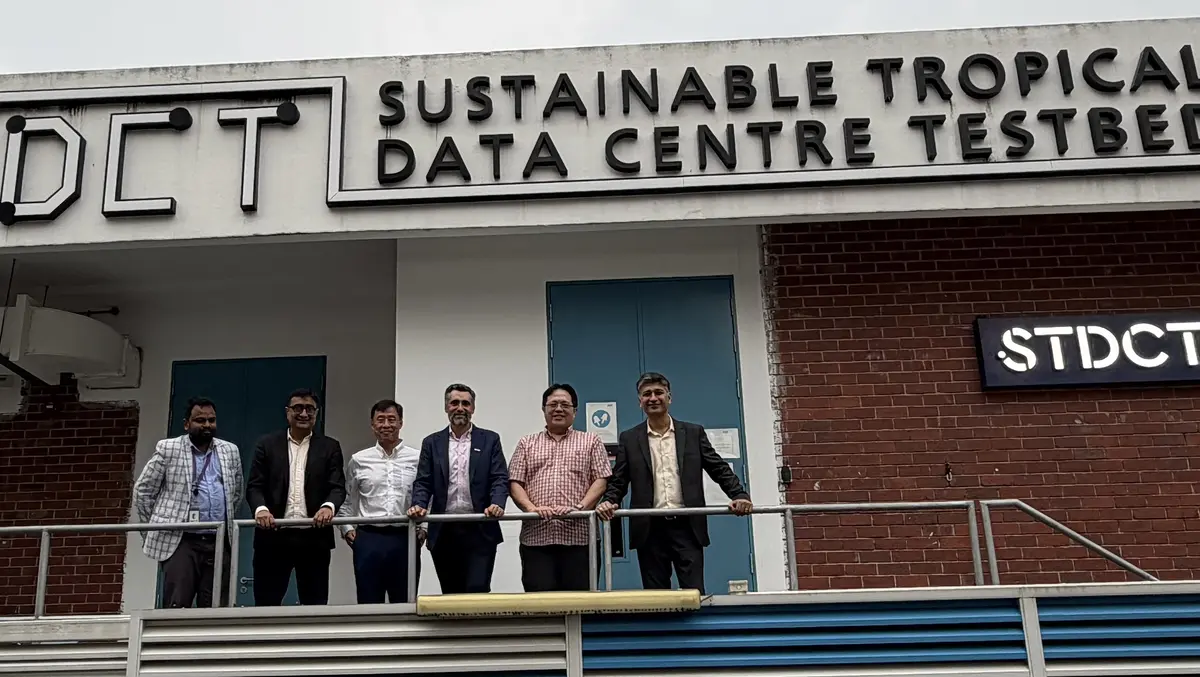
Synopsys joins Singapore tropical data centre testbed
Tue, 10th Nov 2026 (Today)
Synopsys has joined the Sustainable Tropical Data Centre Testbed 2.0 consortium, led by the National University of Singapore. The collaboration focuses on data centre cooling and digital modelling for tropical conditions.
Hosted by the university's College of Design and Engineering, the consortium brings together industry and academic researchers working on infrastructure for AI and high-performance computing systems. The work will connect engineering simulation, AI-assisted design and reduced-order modelling, validated through a physical testbed.
Data centres in tropical climates face higher cooling demands because of elevated temperatures and humidity. According to the consortium, ambient temperatures often exceed 24-32C and humidity can reach 70-80%, reducing the efficiency of conventional cooling systems and increasing energy use.
The challenge has become more pressing as AI workloads increase rack density, power demand and thermal loads in data centre facilities. Cooling can account for up to 40% of a tropical data centre's total energy consumption, a larger share than in cooler climates.
Cooling focus
Initial research concepts include two-phase direct-to-chip cooling for AI accelerators and digital twins for predictive thermal management. The planned workflow is designed to link detailed simulation of thermal and fluid behaviour with experimental testing in the consortium's live environment.
The partners also plan to work across computational fluid dynamics, multiphysics simulation and AI-assisted thermofluid design. Results validated through the physical testbed are expected to feed into reduced-order models for use in digital twin systems and operational decision-making.
Synopsys will provide software access, technical expertise, training, project mentoring and learning resources as part of the collaboration. The broader programme is intended to support research, technology validation and skills development for practitioners working on tropical data centres.
Brandon Wang, Vice President, Technology Strategy & New Horizons at Synopsys, said, "At Synopsys, we look beyond today's opportunities to the new horizons that can strengthen our technology long term. Through our Technology Intelligence Centre, our team connects emerging technology shifts with Synopsys capabilities and leading research ecosystems to turn promising ideas into strategic opportunities. Our collaboration with STDCT 2.0 reflects that commitment by bringing our silicon-to-systems engineering capabilities into a real-world environment for sustainable AI infrastructure."
The project reflects a wider effort in Singapore to build data centre technology suited to regional operating conditions. Southeast Asia has become an important market for data centre expansion, but operators in the region must balance rising demand for computing capacity with pressure to manage electricity and water use.
Testbed model
The Sustainable Tropical Data Centre Testbed is a joint research initiative led by the National University of Singapore and hosted by its College of Design and Engineering. It serves as a live environment where research institutions, data centre operators and technology suppliers can test systems intended to improve energy and water efficiency in hot, humid conditions.
The second phase of the testbed focuses on energy efficiency, water efficiency, green energy, AI and future data centres, and green computing. Its structure allows members to move from simulation and design work to physical validation under conditions intended to reflect operating environments in tropical markets.
Padmesh Mandloi, Vice President, Synopsys Simulation and Analysis APAC at Synopsys, said, "Efficient AI infrastructure requires a clear understanding of interconnected multiscale and multiphysics behavior, from chips to data centers. By combining Ansys multiscale and multiphysics simulation, AI-assisted engineering and surrogate modeling with STDCT 2.0 test data, we can help researchers connect and exchange data across scales, validate designs, and develop scalable cooling and digital twin solutions."
The collaboration also includes work on reusable workflows, case studies and validation methods, alongside a demonstration linking design, simulation, reduced-order model generation, digital twin integration and physical testing. That approach is intended to make it easier to compare design options and assess how cooling strategies perform before deployment.
Professor Lee Poh Seng, Programme Director, Sustainable Tropical Data Centre Testbed, and Head, Department of Mechanical Engineering, College of Design and Engineering at NUS, said, "STDCT 2.0 provides a co-innovation platform to move promising technologies from simulation to validation and towards real-world deployment in tropical data centers. By combining Synopsys' multiphysics simulation, AI-assisted engineering and digital modelling capabilities with our physical testbed, we aim to develop validated, scalable cooling and digital twin solutions for increasingly dense, AI-ready infrastructure in Singapore and across the region."