


Quobly & Hon Hai launch QPE toolbox for researchers
Fri, 15th May 2026
Quobly and Hon Hai Research Institute have released an open-source toolbox for Quantum Phase Estimation, aimed at researchers and academics working on fault-tolerant quantum computing.
The toolbox centres on Quantum Phase Estimation, or QPE, an algorithm often discussed as a way future quantum computers could calculate the ground-state energies of molecular systems. That makes it relevant to quantum chemistry and materials science, where researchers are assessing whether such calculations could be performed at useful scale on fault-tolerant machines.
A central challenge in the field is that QPE is well understood in theory but far less explored in realistic numerical settings. Simulating the algorithm beyond small examples is difficult, leaving open questions about the resources it would require and the trade-offs involved in practical implementations.
Practical modelling
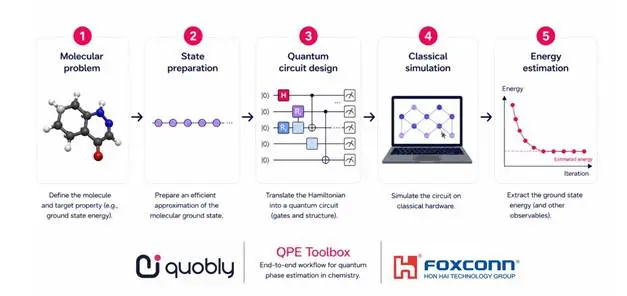
The new toolbox is designed to let researchers study those questions in a more concrete setting. It spans the workflow from chemistry preprocessing to phase estimation, with an emphasis on testing implementation choices and understanding the constraints that emerge when moving from theory to numerical experiments.
Built on tensor network methods, the software uses the open-source quimb library and connects with established quantum chemistry tools including PySCF, allowing researchers to fit it into existing workflows.
According to the partners, users can prepare physically motivated initial states with Density Matrix Renormalisation Group and matrix product states. They can also encode molecular Hamiltonians into quantum circuits through trotterization, block encoding and qubitization; compare standard QPE with single-ancilla Robust Phase Estimation; and analyse circuit depth, gate counts and error sources without running every circuit.
The software is positioned as an exploratory and educational framework rather than a direct simulation of early fault-tolerant quantum computers. Instead, it is intended for numerical experiments that remain within reach of classical computing while still enabling close study of algorithmic choices, state preparation and Hamiltonian encoding strategies.
Scale and limits
The examples provided by the two organisations suggest the toolbox can support full circuit executions for around 10 to 20 qubits and circuits ranging from fewer than 1,000 gates to roughly 100,000 gates. It can also be used for ground-state preparation and Hamiltonian encoding for systems of around 20 to 30 qubits, typically within a few hours or less on a standard laptop.
That places the tool between simple classroom demonstrations and the much larger systems fault-tolerant quantum computing is ultimately meant to tackle. Its value for researchers lies less in claiming to model a complete future machine than in examining how precision, circuit depth and resource requirements interact in settings that can still be studied in detail.
The release also reflects a broader push in quantum computing to tighten the link between hardware development and algorithm design. Quobly works on silicon-based quantum computing, while Hon Hai Research Institute is the research arm of Hon Hai Technology Group, also known as Foxconn.
The package was jointly developed with the Taiwanese institute and released as open source, free for academics and researchers to use.
"Our goal is to provide a practical, numerical playground for QPE, one that helps researchers move beyond purely theoretical cost models and develop realistic intuition for fault-tolerant quantum algorithms," said Thibaud Louvet, quantum algorithms scientist at Quobly.
Hon Hai Research Institute said the project is intended to provide a structured environment for studying what future quantum applications may require in practice. Its quantum computing research arm took part in the development.
"By combining state-of-the-art quantum algorithms with advanced tensor-network techniques, this toolbox offers researchers a structured environment to explore and better understand the practical requirements of future quantum applications," said Hsieh.
Quobly, based in Grenoble, was founded in 2022 and develops silicon quantum chips using semiconductor manufacturing methods. It has said it raised EUR €19 million in 2023 and a further EUR €21 million in 2025. Hon Hai Research Institute was founded in 2020 and is part of Foxconn's broader research effort across five centres.