

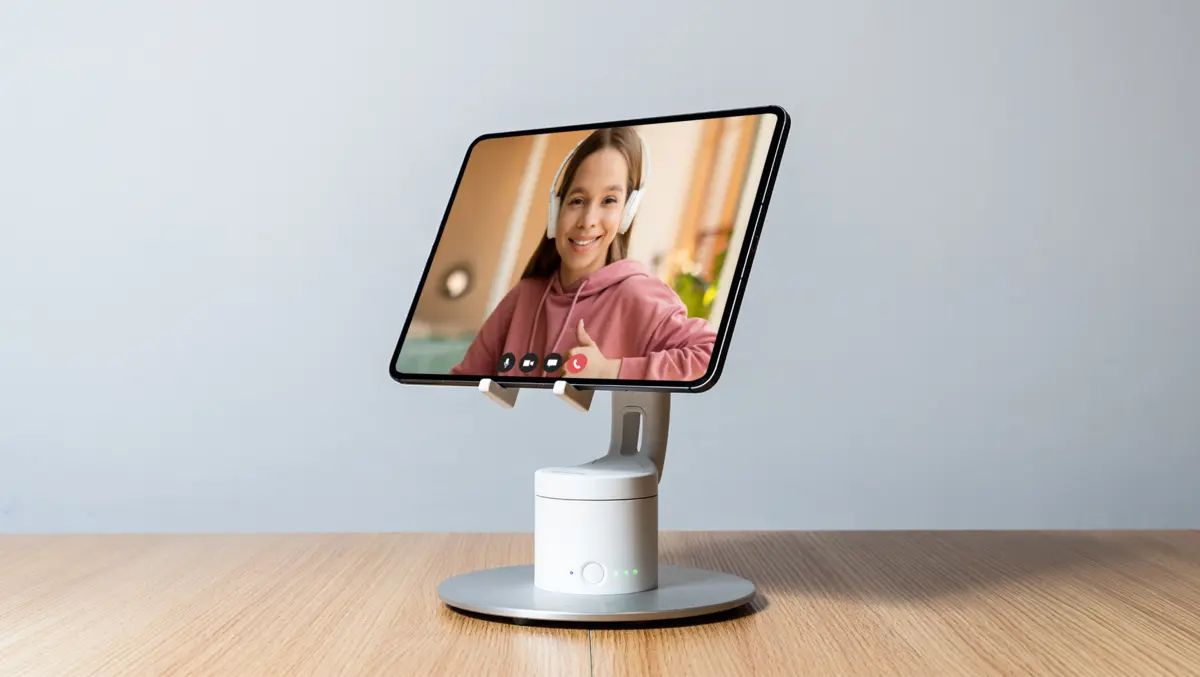

iPresence will launch kubi 2.0 on Kickstarter in the Japanese company's first direct global product launch.
The desktop telepresence robot is a redesigned version of the original kubi, which iPresence has supplied in Japan since 2015 after obtaining a manufacturing and sales licence from Xandex, the former US manufacturer. The new model was rebuilt in Japan after a review of the mechanism, electronic parts and production process, drawing on customer feedback collected over the past decade.
kubi 2.0 is aimed at remote communication in schools, hospitals, welfare settings and offices. It is also being positioned as a device for AI agents that need a physical presence in front of users. Remote users can control the unit from a smartphone, tablet or computer, with up to 300 degrees of horizontal rotation and 55 degrees of vertical movement.
The launch also includes a donation option intended to let backers fund units for schools, hospitals and other eligible recipients. The scheme is designed to address a gap between institutions that see a need for remote access tools and supporters who want to help but do not know how.
Product redesign
iPresence has changed several elements of the device from the previous model, including a magnetic tablet mount, a lower centre of gravity, quieter movement and USB Type-C charging.
Those changes reflect efforts to address practical issues raised by users in real settings. The original kubi remained in demand after production ended, prompting iPresence to work with Japanese manufacturing partners on a revised version.
Classroom use
One of the main use cases is education for children who are absent from school because of medical treatment. In that setting, the robot lets a remote user turn towards a teacher during lessons and towards classmates during breaks, rather than relying on a fixed camera view.
Field trials in education showed that maintaining that link could reassure children receiving treatment, as well as classmates, friends and teachers. iPresence argues that being able to direct one's own view can help preserve a sense of participation in classroom life.
Healthcare and welfare environments are another target market, particularly for consultations or support from specialists who are not on site. Office meetings are also part of the intended use, extending the product beyond education.
AI presence
Alongside human-operated telepresence, iPresence is promoting kubi 2.0 as a platform for AI-based interaction. The company says simple physical actions such as turning towards someone or nodding during a conversation could change how people respond to an AI agent.
It plans to offer its own AI agent application, combining face tracking with AI-led conversation and guidance. Proposed uses include reception desks and showrooms, where human-operated remote support and automated assistance could be switched according to the situation.
iPresence also plans to make an API available to outside developers so third-party AI applications can control the device's movements. That would widen the range of services that can be built around the robot if developers adopt the platform.
Global reach
The Kickstarter campaign will cover a broad range of markets. Product delivery is planned for Japan, North America, parts of Europe, selected countries in the Middle East and Africa, several Asian markets, and Australia and New Zealand. Backers in other regions will be able to support the project without receiving the product.
For iPresence, the campaign marks a shift in how it brings products to market. Rather than relying only on conventional distribution, the company is using crowdfunding to reach users directly and gather feedback from overseas customers as it develops later versions and applications.
The business, founded in Kobe in 2014, has focused on telepresence avatar robots and 3D digital twin services. kubi 2.0 combines that telepresence work with a newer emphasis on what iPresence describes as physical AI.
Chris Francis Christophers, President and CEO of iPresence, said the campaign would offer both early-access purchases and donation rewards for schools and hospitals.