

Suprema & Hyundai teams plan robot-ready smart homes
Thu, 19th Mar 2026
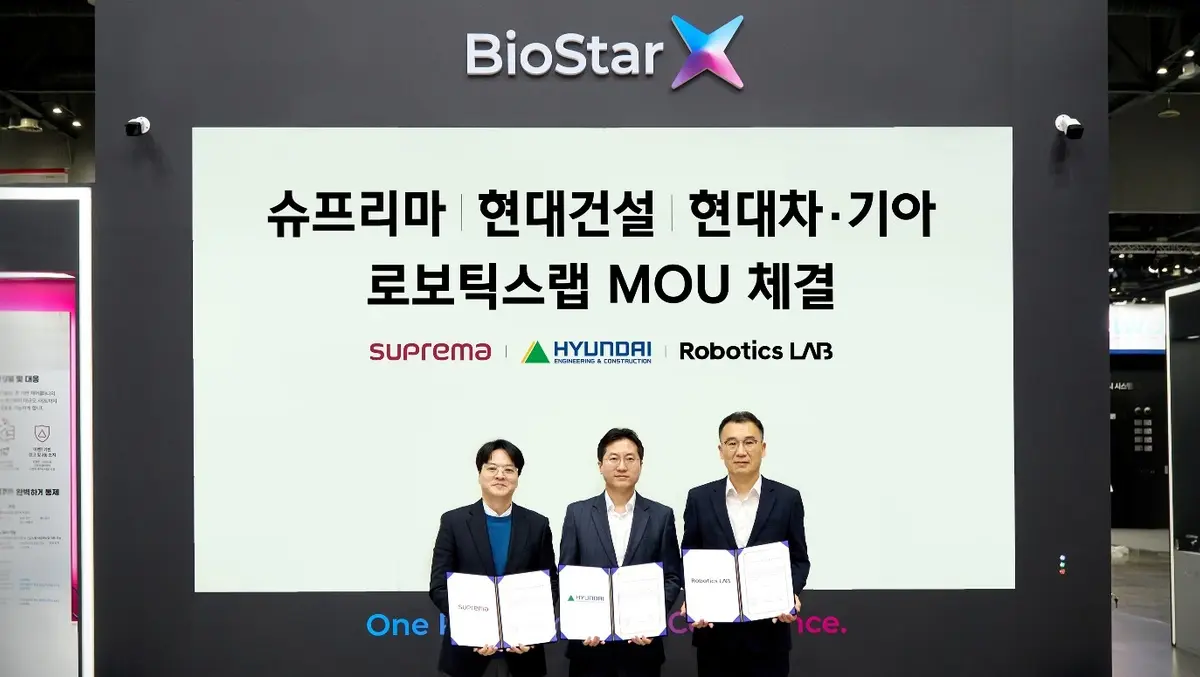
Suprema has signed a three-party memorandum of understanding with Hyundai Motor Group Robotics LAB and Hyundai Engineering & Construction (Hyundai E&C) to integrate service robots, building design, and access security in residential complexes.
The companies will develop models for robot-enabled housing, with robots handling tasks such as delivery, guidance, and patrols in shared areas. The agreement links three areas increasingly treated as interdependent in dense residential settings: robot mobility, resident authentication, and building infrastructure.
Under the arrangement, Suprema will build the integrated security infrastructure and serve as system integrator, connecting robot platforms with building security systems. It plans to use AI facial authentication and its BioStar X unified security platform.
Hyundai Motor Group Robotics LAB will develop robot services for residential environments and lead work on technical standards based on autonomous robots and its Robotics Total Solution platform. Hyundai E&C will provide architectural designs that support robot movement and operations, and contribute pilot sites tied to its residential projects.
Phased programme
The collaboration will proceed in phases, including proof-of-concept testing and commercialisation. The companies have not disclosed the scale of initial deployments, pilot locations, or any investment commitments.
Residential robotics has moved beyond controlled demonstrations in recent years, with building operators testing autonomous devices for deliveries, inspections, and security patrols. Wider rollout has raised practical issues around access control, lift integration, identity verification in shared spaces, and robots' ability to navigate entrances and corridors not designed for autonomous movement.
Suprema's role places it at the centre of identity and access management for any deployments that follow. In modern apartment settings, access control typically spans building entrances, lobbies, amenity areas, and service zones, often managed alongside visitor systems and mobile credentials. Suprema is positioning AI-based authentication as a way to distinguish residents from outsiders in spaces where robots operate.
Hyundai Motor Group Robotics LAB has been developing autonomous robot platforms and related software as part of a broader robotics effort. In this partnership, it will define residential robot services and develop standards that could shape how robots interface with building systems and security rules.
For Hyundai E&C, the agreement ties robotics deployment to architectural planning. "In future residential complexes, the construction company's key role will be to design robot-friendly living environments where a variety of service robots and residents can coexist naturally," said Seung Min Oh, Executive Vice President of Hyundai E&C.
Security and standards
A central question for residential service robots is how permissions are granted and enforced across spaces that mix private and shared access. Robots may need to move between entrances, lifts, corridors, and designated delivery points, while controls must account for residents, visitors, contractors, and building staff.
Suprema's chief executive framed the project as a security requirement driven by robots' expanding role in residential spaces.
"As service robots begin to perform delivery, guidance, and patrol tasks throughout residential spaces, an AI-powered security infrastructure becomes essential to ensure that robots and residents can coexist safely under unified security rules," said Hanchul Kim, CEO of Suprema.
Ri Goon Choi, Executive Director of Hyundai Motor and Kia Robotics LAB, described robot services and the built environment as a single design problem rather than a bolt-on. "A truly advanced residential complex based on service robots can achieve competitiveness only when robotics, architecture, and security systems are designed as one integrated infrastructure," he said.
The three parties also said they aim to set new technical standards for residential robotics. Standards can speed deployment across sites by reducing the need for bespoke integration with access control systems, lifts, doors, and building management platforms.
Suprema said it will connect robot platforms with building security systems as system integrator. "Based on our AI-powered unified security platform BioStar X and Suprema's proven biometric and mobile access authentication technologies, we will work with Hyundai Motor Group Robotics LAB and Hyundai E&C to lead a new era of residential security powered by robotics and AI, expanding from proven domestic references to the global residential security market," Kim said.
Hyundai E&C said it expects demand for robot services to grow in large residential developments, with building design used to make robot operations more natural and reliable. "By creating demand for residential robot services and combining Hyundai Motor Group Robotics Lab's robotics technology with Suprema's AI security solutions, we aim to lead the development of service robot-based residential complexes that enhance resident mobility, convenience, and safety," Oh said.