


Starburst launches Enterprise Intelligence Platform for AI
Mon, 1st Jun 2026.webp)
Starburst has launched its Enterprise Intelligence Platform, centred on the wider availability of AIDA, its AI interface for business users.
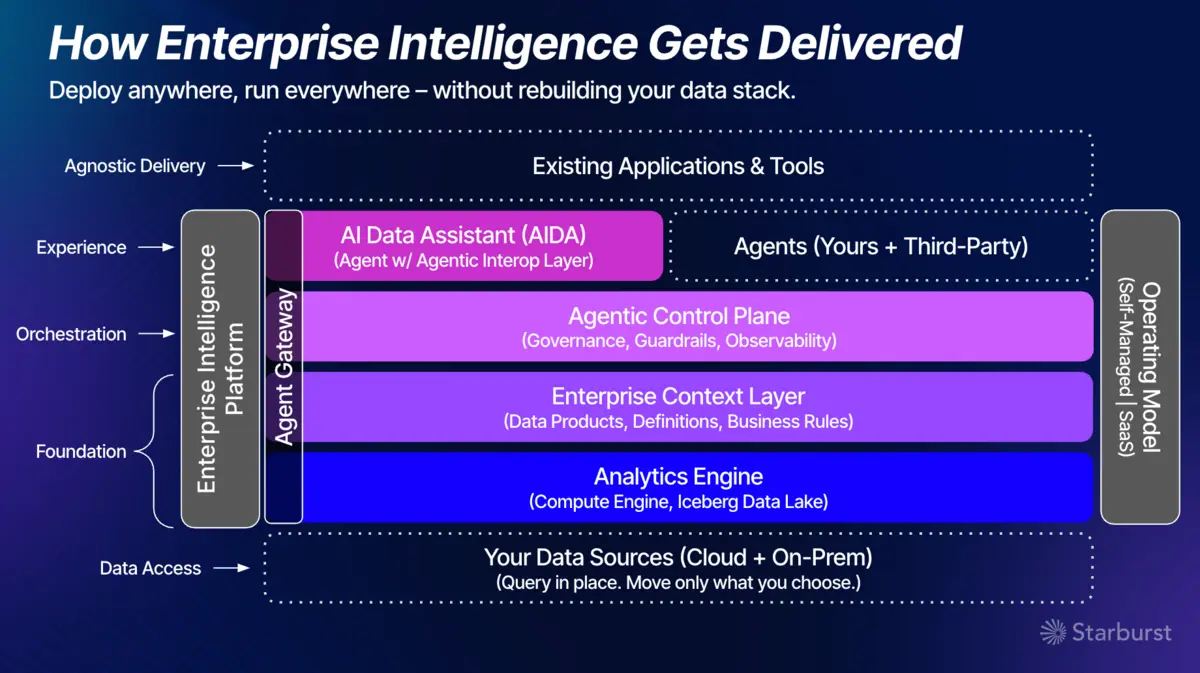
The platform is designed to let companies run AI on governed data across distributed systems without moving that data into a central repository. It also includes AI-Ready Data Products, new Apache Iceberg management tools, and a Bring Your Own Cloud deployment model for customer-managed infrastructure.
The announcement comes as companies try to expand AI projects while controlling the cost and risk of working with fragmented corporate data. Starburst cited research from Mavvrik showing that 84% of companies report AI costs are reducing gross margins by more than 6%.
According to Starburst, data spread across clouds, data lakes, software applications, and operational systems has made AI projects more expensive and less reliable. The platform is intended to provide a single layer for AI and analytics across those systems while maintaining governance and business context.
AIDA rollout
AIDA, now generally available, sits at the centre of the launch. It works inside the existing workflows, applications, and software agents used by business teams, rather than requiring users to switch to a separate analytics environment.
AIDA can generate visualisations and trigger actions across connected systems, including opening tickets, updating records, and starting processes. It also supports the Model Context Protocol, which Starburst said enables connections to external tools, unstructured content, and third-party systems.
Justin Borgman, Co-Founder and Chief Executive Officer of Starburst, outlined the company's position on enterprise AI adoption.
"AI has outpaced data architecture," said Justin Borgman, Co-Founder and Chief Executive Officer, Starburst. "Most enterprises are trying to layer AI on top of fragmented, ungoverned data, and it's not working. At AI & Datanova, we're showing a different path. With the Enterprise Intelligence Platform and AIDA, organizations can finally operationalize AI - in weeks, not months - on top of the data they already have, without moving it or rebuilding their stack."
Data context
Another part of the launch is a set of AI-Ready Data Products designed to package governed data, metadata, and business definitions into reusable assets for analytics and AI. The approach is intended to avoid forcing companies to recreate semantic definitions from scratch in each new system.
Starburst also previewed what it described as a query-in-place approach to business context already held across catalogues, business intelligence tools, and data pipelines. Data Products as Code has entered public preview, while Automatic Metadata Enrichment is generally available.
That focus on governed, contextualised data reflects a broader shift in enterprise AI strategies, according to industry analysts.
"Enterprises are realizing that scaling AI depends less on the models and more on access to trusted, governed data across complex hybrid environments," said Brad Shimmin, VP & Practise Lead, Data Intelligence, Analytics, and Infrastructure, The Futurum Group. "The industry is shifting toward architectures that reduce data movement while preserving governance and business context. Starburst's latest announcement reflects that trend with a focus on distributed data access, embedded AI, and enterprise-scale analytics performance."
Iceberg operations
Starburst also expanded support for Apache Iceberg, the open table format increasingly used in lakehouse architectures. It introduced Managed Icehouse, which covers ingestion and table operations for Iceberg environments.
Managed Icehouse includes Icehouse Ingest for streaming and batch file ingestion, and Icehouse LakeOps for table optimisation, query tuning, and table health monitoring. These tools are aimed at companies running open lakehouse infrastructure across hybrid and multi-cloud setups.
The launch material also refers to Iceberg as the default table format in Galaxy, Starburst's cloud service. That places the company more firmly in the growing market for open data formats and interoperability, where customers have sought alternatives to proprietary platforms.
Cloud control
A Bring Your Own Cloud model is also part of the update. Under this setup, customers keep compute, networking, and data inside their own cloud accounts while using Starburst-managed software.
The option is in preview and is aimed at organisations that want tighter control over infrastructure, security, and compliance arrangements. It is likely to appeal to companies in regulated industries or those with strict internal requirements for data residency and cloud governance.
One customer cited by Starburst described efforts to build a governed internal data marketplace and reusable data products across a complex healthcare environment.
"At Vizient, we're focused on improving how teams across the organization access, connect and use trusted data in a complex healthcare environment. As part of that effort, we've been building the foundations for a governed internal data marketplace and reusable data products that support cross-domain analytics and AI enablement. Our approach incorporates a range of technologies, including Starburst, to help teams work more effectively across distributed datasets while reducing unnecessary data duplication," said Ram Radhakrishnan, Engineering Leader - Data & AI Platforms, Vizient.