

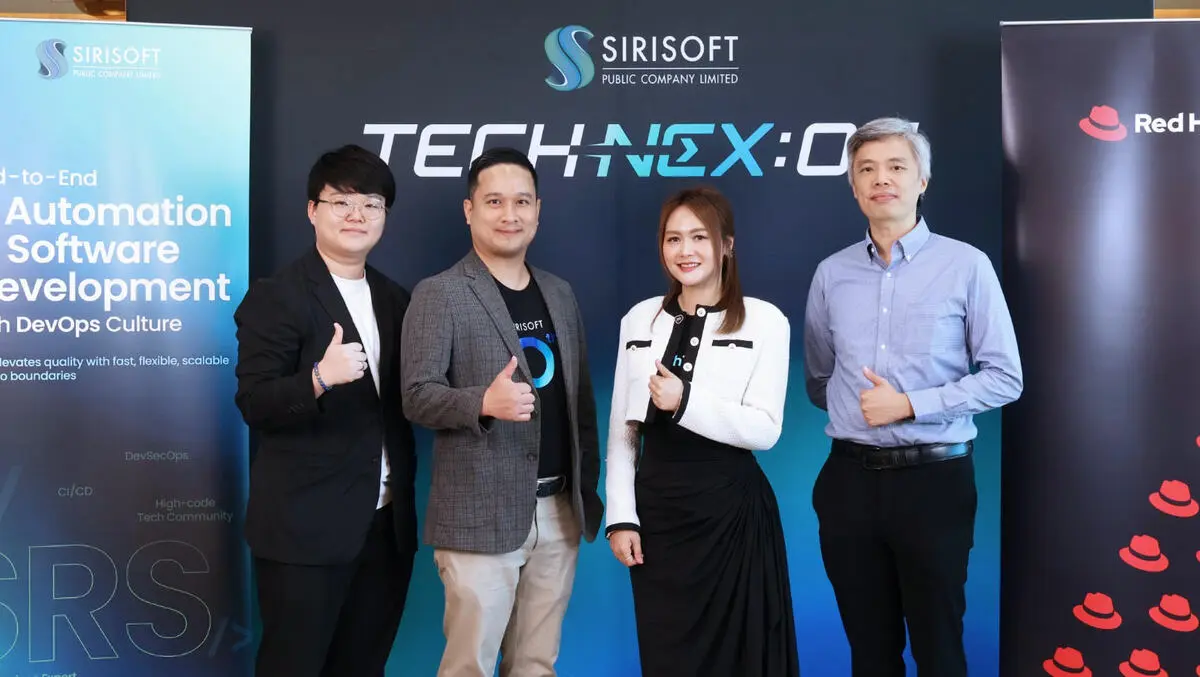
Sirisoft & Red Hat champion automation for AI-ready IT
Wed, 7th Jan 2026
Thai IT consultancy Sirisoft has partnered with open-source software group Red Hat on a seminar that framed automation as a central pillar of long-term technology investment and AI strategies for enterprises.
The event, titled "Investing in Intelligence: The Red Hat Ansible Automation Platform", focused on how automation and AI-focused IT operations can reshape the way organisations assess return on investment from digital initiatives. Speakers highlighted a shift from cost-cutting towards broader measures of value that include speed, agility and new digital capabilities.
The seminar centred on Red Hat's Ansible Automation Platform, which the companies positioned as an engine for standardised automation across infrastructure, applications and security operations. The organisers targeted Thai enterprises that are reassessing their technology portfolios as they expand digital services and explore AI deployments.
ROI redefined
Detchapol Laemwilai, Chief Growth Officer of Sirisoft, said many organisations now view automation and AI as essential investments in competitiveness rather than optional cost-saving projects.
"Investment in automation is therefore not only about reducing time or errors in repetitive tasks, but also about being a crucial mechanism to deeply enhance efficiency at every level of the organization-ranging from accurate data analysis and improved work quality to scalability and empowering personnel to focus more on strategic work. However, such investments will deliver real ROI only when the organization has clear goals, can identify in which areas the investment will create value, and understands how the outcomes align with the organization's direction. When there is a comprehensive understanding in all these dimensions, automation becomes a critical gear that drives growth and strengthens the business sustainably over the long term."
Sirisoft focuses on consulting and software development services for enterprises. The company builds systems on microservices architecture and applies DevOps practices across application development and operations.
Detchapol said boards and executive teams increasingly assess IT projects on their contribution to revenue growth, service innovation and resilience. He contrasted this with earlier approaches that focused on labour savings and budget cuts.
Automation as infrastructure
Red Hat executives used the event to describe automation as a structural element of modern IT environments rather than a narrow tool for task reduction.
"Automation technology today is no longer just a tool to reduce repetitive tasks, but has become a strategic infrastructure that helps organizations manage the complexity of IT systems and respond reliably to rapid change. Red Hat Ansible Automation Platform serves as a key engine for creating standardized, transparent, auditable, and scalable automation across the organization-for infrastructure management, application operations, and security enhancement. Its key strengths are ease of getting started and extensibility, helping reduce errors from manual work, promoting knowledge transfer, and allowing IT experts to focus on higher-value tasks. This demonstrates that automation is the key to increasing agility and laying a solid foundation for organizational innovation, with Ansible Automation Platform at the heart of this transformation," said Suppanee Amunatmongkol, Country Manager, Red Hat (Thailand) Limited.
Red Hat has promoted Ansible as a common automation layer that spans data centres, clouds and edge environments. The company positions the platform as a way for IT teams to codify processes, reduce manual interventions and govern change across mixed infrastructure.
Sirisoft and Red Hat stressed that automation projects increasingly form part of wider digital transformation agendas. These often include modernisation of legacy systems, adoption of containers and Kubernetes, and preparation for AI workloads that demand consistent infrastructure and reliable data flows.
Event-driven focus
Stefanus Soehono, Ecosystem Solutions Manager for Southeast Asia and Korea at Red Hat, linked automation directly with the practical deployment of AI in complex environments.
"Modern enterprise IT environments are increasingly complex and fast-changing, especially where infrastructure, applications, and data must be operated and managed simultaneously. Relying on AI alone without integrating automation can cause delays or errors in critical processes. Therefore, applying an Event-Driven Automation approach together with Red Hat Ansible Automation Platform is essential to increase agility, reduce the repetitive workload of IT teams, and create systems that automatically respond to various events. This enables organizations to manage complexity in a reliable and efficient way, while allowing IT teams to focus on higher-value work and building readiness and flexibility for future adaptation and innovation," said Soehono.
Event-driven automation links system signals or business events with automated responses. This can include scaling resources when demand spikes, enforcing security policies when anomalies arise, or triggering remediation workflows when monitoring systems detect issues.
Sirisoft said demand for such approaches is rising in Thailand as organisations connect more systems, expose more services to customers and regulators, and manage larger volumes of operational data. The company provides design, monitoring, incident resolution and maintenance services that sit alongside automation tooling.
The partners indicated that they expect continued interest from enterprises, companies and developer communities that are seeking to convert manual, repetitive IT tasks into automated workflows based on Ansible.