

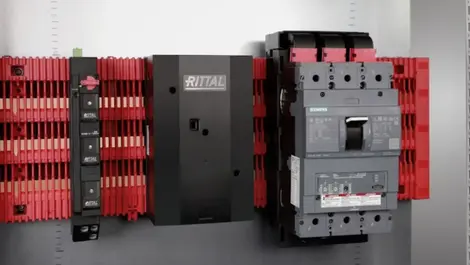
Siemens, Rittal ally to power next-gen AI data centres

Siemens and Rittal have formed a strategic partnership to develop power distribution systems for AI-driven data centres in markets that use IEC standards.
They plan to create standardised infrastructure that can keep pace with the rapidly changing demands of AI computing. The partners pointed to a sharp rise in rack power densities in AI data centres, driving changes in how facilities design power distribution.
As AI training and inference expand, power density has become a key constraint for operators. In many AI deployments, rack-level demand now exceeds 100 kW. By 2030, the partners expect rack power density to climb further-potentially beyond 1 MW in some scenarios-placing greater demands on electrical distribution, cooling design, and heat-recovery approaches.
Sidecar design
The first planned outcome is a next-generation "sidecar" power rack designed for deployment directly in a data centre's white space-the area that houses server cabinets and storage systems. In this concept, power electronics sit in a dedicated rack that supplies adjacent server racks.
The approach is intended to deliver scalable power within the IT area. Expansion would be simplified by adding modular units as demand grows. It also reduces the distance between power conversion equipment and IT loads, which becomes increasingly important as current levels rise.
The sidecar design is expected to align with OCP standards, a common reference point for open hardware in hyperscale and AI infrastructure. It will combine tested technology from both companies and is intended to support fast deployment and reliable operation in data centre environments.
Standardised distribution
Beyond the sidecar unit, the partnership includes a broader programme focused on standardised low-voltage distribution. This work will cover modular and containerised data centres, which are gaining momentum as operators seek repeatable building blocks that can be deployed in stages.
The collaboration also includes projects focused on operational and personal safety, which become more complex as electrical loads increase and equipment moves closer to IT hardware. Initial customer projects have already started, though no customers or sites were named.
Several elements will rely on coordinated components from Siemens and Rittal power distribution platforms, including RiLineX and Ri4Power from Rittal Energy & Power Solutions. These platforms typically define how busbars, switchgear, and related elements are arranged inside distribution systems.
Roles and reach
Siemens Smart Infrastructure will contribute products and systems used in power distribution. Rittal will provide expertise in racks and standardised data centre infrastructure, including power and cooling equipment. Rittal supplies infrastructure to hyperscalers, among the earliest adopters of high-density AI deployments.
The partnership targets IEC markets, including much of Europe and other regions that follow International Electrotechnical Commission standards. Standardisation in these markets can influence component selection, electrical design choices, and compliance practices for operators and builders.
Prof. Dr. Friedhelm Loh, Owner and CEO of the Friedhelm Loh Group, described the partnership as an extension of existing work between the companies.
"We have a long-standing collaboration with Siemens in a number of fields. We are proud to be taking our partnership to the next level," said Prof. Dr. Friedhelm Loh, Owner and CEO, Friedhelm Loh Group.
Siemens Smart Infrastructure linked the collaboration to scaling AI data centre growth and accelerating delivery of electrical infrastructure projects.
"To enable the rapid growth of AI, we need smart, reliable, and scalable power supply solutions for data centers and we need them quickly. In combination with our innovative electrical products and solutions, Rittal is an ideal partner when it comes to speed and standardization in infrastructure," said Andreas Matthé, CEO Electrical Products, Siemens Smart Infrastructure.
Over time, both companies expect the collaboration to extend beyond data centres, with additional industries and applications under consideration as joint development progresses.