

Midea unveils AI data centre cooling push in Singapore
Wed, 30th Sep 2026 (Today)
Midea Building Technologies has unveiled a white paper on power and cooling architecture for AI data centres and presented a liquid cooling product line in Singapore, targeting the Asia-Pacific market.
Developed with Clou Electronics, the white paper outlines what Midea describes as a power-cooling hyper-converged architecture for next-generation AI data centres. It combines electrical power, energy storage, chillers and liquid cooling distribution units in a single system design.
The announcement comes as data centre operators across Asia face rising demand for infrastructure that can support denser AI workloads. Midea says global compute demand is increasing at a compound annual growth rate of about 26% to 36%, while next-generation AI server racks are moving towards 600 kW per cabinet.
That shift is putting pressure on traditional power and cooling systems, especially in Southeast Asia, where operators must also contend with high temperatures, humidity, stricter energy efficiency requirements and limits on water use.
Cooling focus
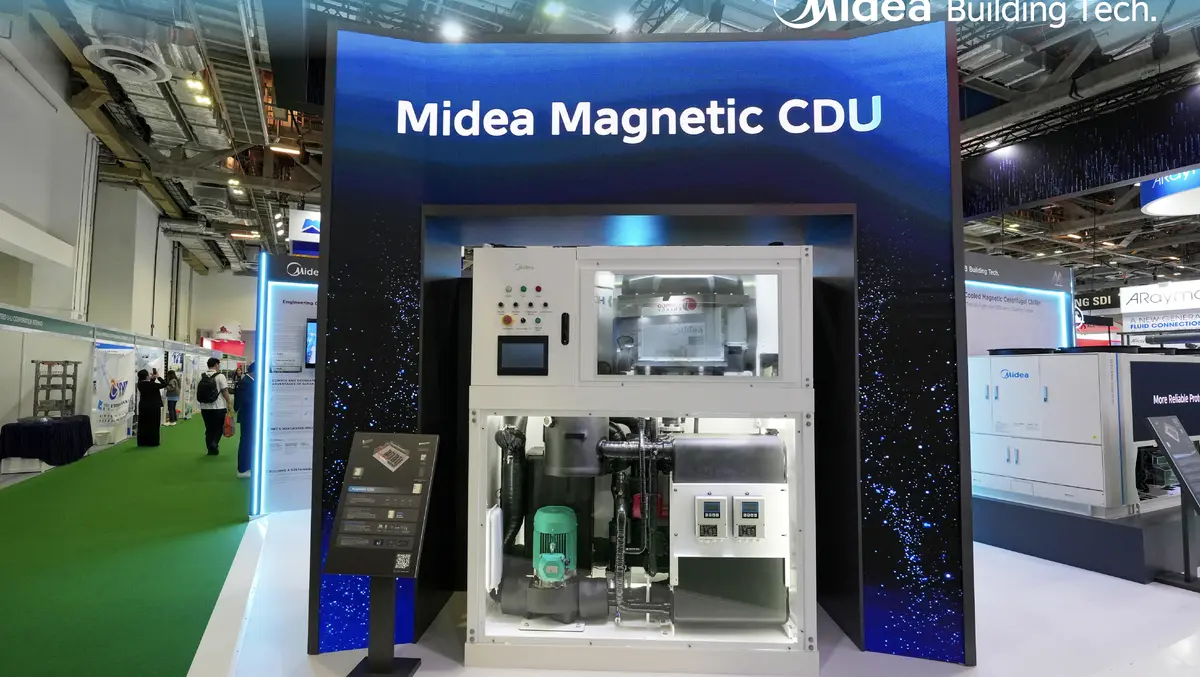
Alongside the white paper, Midea presented what it calls a full-stack cooling system for AI data centres. The line-up includes a Magnetic CDU, an Air-Cooled Magnetic Bearing Centrifugal Chiller and an Industrial-Grade CDU.
According to Midea, the Magnetic CDU combines a cooling source and distribution unit in one system, replacing a traditional set-up based on a chiller and passive CDU. The design cuts floor space by more than 70% and removes the need for complex on-site commissioning, the company says.
For operators in tropical markets, Midea says the system can support a power usage effectiveness figure below 1.2. It adds that the air-cooled magnetic bearing centrifugal chiller is designed for hot climates and water-scarce sites, with a coefficient of performance of up to 5.4.
The Industrial-Grade CDU has a cooling capacity of 2.6 MW across a 3K temperature differential, according to the company. Midea says this makes it suitable for continuous use in high-density computing environments where uninterrupted operation is critical.
Regional push
Asia-Pacific has become a priority market for data centre equipment suppliers as cloud providers, colocation groups and enterprise customers expand AI infrastructure. Midea is seeking a deeper role in that buildout by linking individual products with a broader systems design approach.
The company argues that competition in the market will increasingly be shaped by how power, cooling, controls and operations are integrated, rather than by individual pieces of equipment alone. That view reflects a wider industry shift as operators look to manage electricity use, heat loads and uptime in larger AI facilities.
Keppel project
Midea also used the Singapore event to highlight its work with Keppel on the Gui'an Midea Cloud Data Centre in Guizhou Province. The site combines Midea's heating, ventilation and air conditioning systems and lifts with Keppel's digital platform.
According to Midea, the facility delivers 7,654 hours of annual free cooling and keeps PUE below 1.2. The project is being presented as an example of how physical infrastructure and digital operational systems can be combined at large data centre sites.
The partnership with Keppel gives Midea a reference project as it targets Asia-Pacific customers seeking evidence of deployment at scale. For data centre operators, examples of live facilities remain important as cooling technology shifts from conventional air-based systems towards greater use of liquid cooling in AI environments.
Midea has been active in the data centre market since 2007 and says it has built a product range spanning precision air conditioning, magnetic bearing chillers and liquid cooling distribution units. The company operates seven research and development centres and 16 manufacturing bases worldwide, and says it holds more than 7,000 authorised patents.
The wider Midea group, founded in 1968, has businesses spanning smart home products, industrial technology, building technologies, robotics and automation, and energy systems. Within that structure, Midea Building Technologies focuses on heating, ventilation and air conditioning, lifts, AI data centre and energy storage systems, and energy management.
Its latest push into AI data centre cooling reflects how equipment suppliers are seeking a larger role in one of the fastest-growing segments of digital infrastructure. As data centre operators in Asia add denser AI hardware, balancing power demand, heat removal and water use is becoming a central design challenge.