

Keeper updates iPhone Duo app with redesign & autofill
Wed, 4th Nov 2026 (Yesterday)
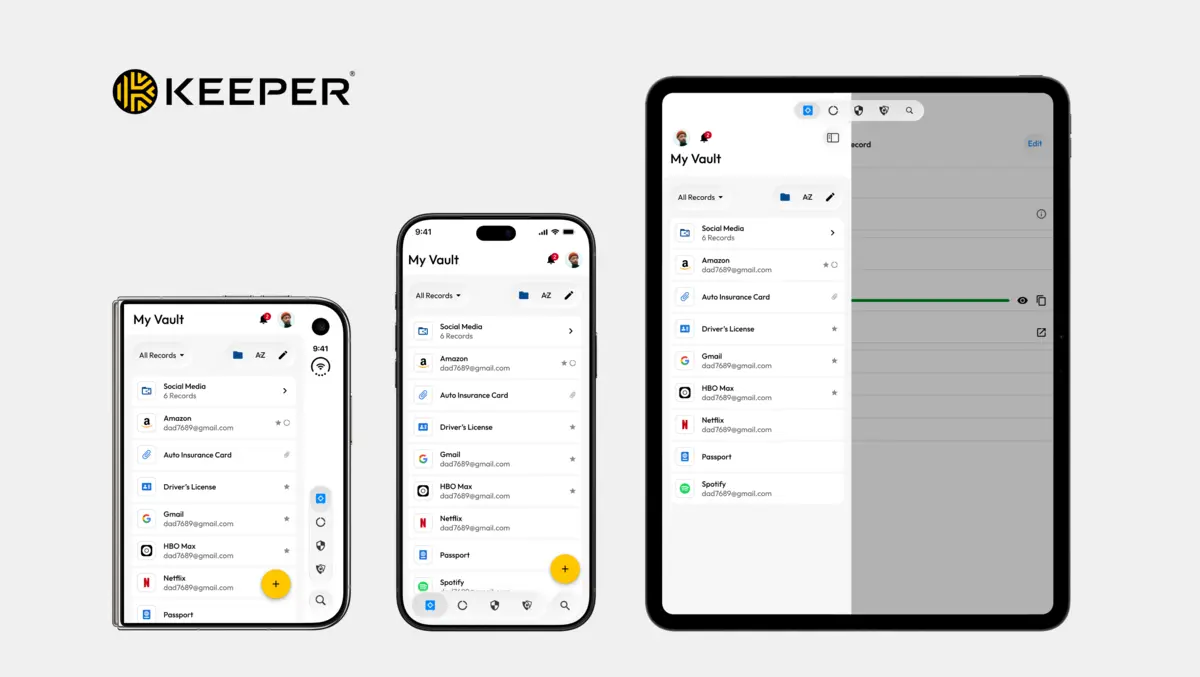
Keeper Security has released version 18.1 of its iOS app, adding support for Apple's dual-screen iPhone Duo.
The update also brings a redesigned vault interface, changes to autofill and password generation, a rebuilt two-factor codes screen, and updates to the Security Audit section.
Keeper says the app has been reworked to align with Apple's Liquid Glass design language and make better use of foldable hardware. On the iPhone Duo, the vault can expand across both screens when the device is open, letting users browse folders on one side and view record details on the other.
When the device is folded shut, the app returns to a single-screen layout. The goal is to reduce navigation steps for people managing credentials on mobile devices.
Interface changes
Several commonly used functions have moved to a bottom toolbar, including search, Security Audit, and two-factor codes. Account settings now sit in an avatar menu, while a floating action button and swipeable product tour have been added to help guide navigation.
The two-factor codes screen has been rebuilt as part of the overhaul. The Security Audit section has also been redesigned to present account health information in plainer language and load more quickly for users with larger vaults.
The latest iOS version also adds visual indicators showing whether the app is syncing or operating offline, along with the ability to share multiple files to Keeper directly from the iOS Activity View.
Automation focus
A major part of the update centres on KeeperFill, the company's autofill tool. The new version can suggest and insert passwords directly into iOS system prompts when users create or reset accounts, while updating vault records in the background.
The app now also handles some credential maintenance tasks automatically. If a website reports that a passkey has been revoked or a password is no longer active, the app can update or clear the relevant vault entry without the user having to make the change manually.
For enterprise customers, Keeper has added controls for moving nested shared folders and denying access to specified folders. Those features form part of the broader mobile redesign rather than a separate enterprise release.
Mobile identity
Keeper framed the update as part of a broader push into mobile identity management, as smartphones take on a larger role in workplace access and administration. The company argues that mobile devices are increasingly used for enterprise operations and privileged access tasks, increasing pressure on software providers to combine security controls with simpler interfaces.
"Friction is the enemy of enterprise security," said Craig Lurey, Chief Technology Officer and Co-Founder at Keeper Security.
"We engineered this update to fully leverage Apple's Liquid Glass design system and the dual-screen architecture of the iPhone Duo, stripping away navigational complexity. The result is a highly responsive, intuitive interface that accelerates access for our users while maintaining the uncompromising zero-knowledge encryption our platform is built on," Lurey said.
Keeper says its platform is built on a zero-trust and zero-knowledge model, with encryption and decryption taking place locally on a user's device using private keys that do not leave the endpoint. It positions that approach as relevant not only for individual password storage, but also for access to cloud infrastructure, databases, API secrets, and other sensitive enterprise systems.
The company also linked the update to broader shifts in corporate security, including the growth of AI agents, non-human identities, and multi-cloud environments. It argues that attacks are increasingly targeting identity workflows rather than traditional network perimeters, prompting organisations to pay closer attention to how credentials, passkeys, and machine identities are governed across devices.
That broader positioning reflects an increasingly crowded identity security market, where software vendors are trying to show that mobile apps are not simply companion tools for desktop platforms, but central points of access in their own right. In Keeper's case, the latest iOS release appears designed to make the mobile app more usable for both consumers and enterprise administrators managing credentials away from a desktop.
The updated app is now available through Apple's App Store.