

Indonesia launches first university-based AI centre
Mon, 17th Aug 2026
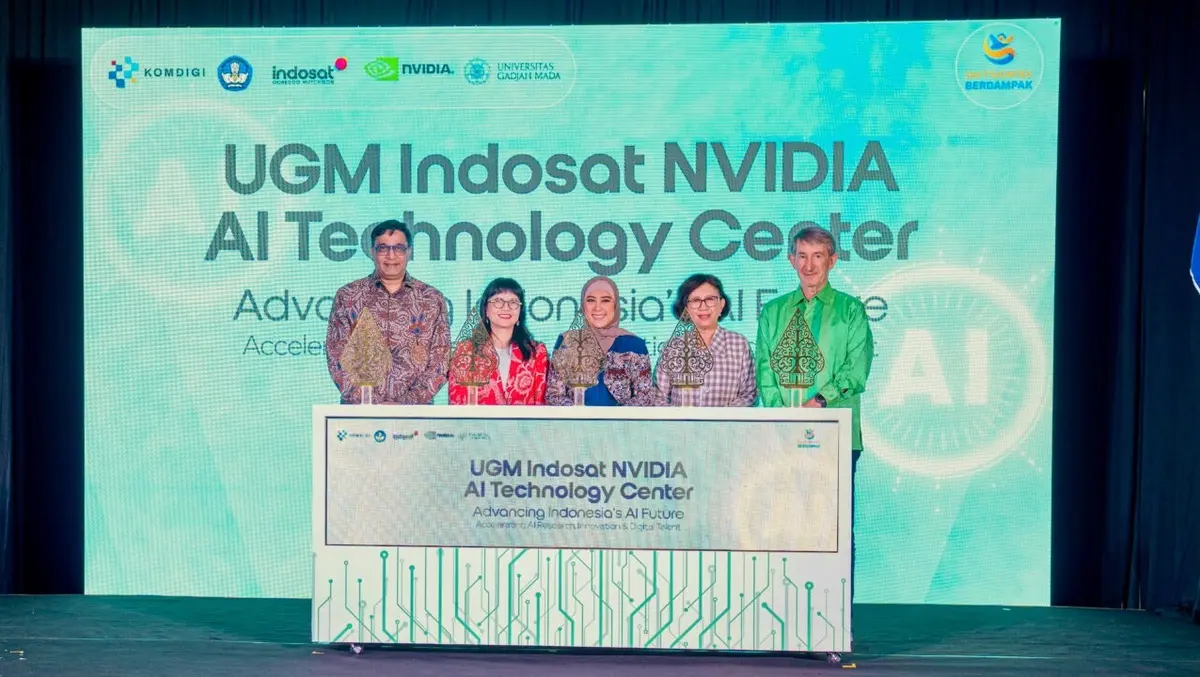
Indonesia's Ministry of Communication and Digital Affairs, Indosat, Nvidia and Universitas Gadjah Mada have launched the UGM Indosat NVIDIA AI Technology Centre in Yogyakarta, described as the country's first university-based AI technology centre.
Established under Indonesia's AI Centre of Excellence initiative, the centre brings together government, industry and academia for research and development aligned with domestic priorities. Its initial focus will be healthcare, agriculture and disaster response, with access for researchers and students at Universitas Gadjah Mada.
Officials presented the launch as part of a broader effort to build domestic AI expertise rather than rely solely on imported tools. The project combines Nvidia's AI software and models with GPU Merdeka, Indosat's sovereign GPU-as-a-service platform, giving local users access to computing resources, development frameworks and technical support.
"The Indonesia AI Centre of Excellence reflects our long-term vision to position Indonesia as a nation that not only adopts AI but also develops and contributes AI innovations to the world," said Meutya Hafid, Minister of Communication and Digital Affairs, Indonesia. "Through initiatives like this, we are laying the foundations of Indonesia's AI sovereignty and ensuring AI becomes a driver of economic growth, national competitiveness and solutions to Indonesia's most pressing challenges."
Universitas Gadjah Mada said the centre would support education, research and the practical application of research. As one of Indonesia's leading academic institutions, the university also gives the initiative a base outside Jakarta as the country seeks to widen access to AI tools and training.
"UGM is committed to supporting Indonesia's AI ambitions through education, research, and innovation that deliver real societal impact," said Prof. Dr. Ova Emilia, PhD, Universitas Gadjah Mada. "This initiative supports national priorities in higher education, research downstreaming and talent development by accelerating the adoption of AI and preparing future-ready Indonesian talent."
Access to compute
A central aim of the programme is to address limited access to computing infrastructure for Indonesian researchers and developers. Indonesia has a large population and a broad research base, but work on local problems has often been constrained by the availability of advanced hardware, AI models and related software tools.
The centre is intended to extend access beyond a single campus by linking researchers, students, startups and other innovators into a wider network. For Indosat, the facility is part of a broader push to build domestic digital infrastructure around AI.
"At Indosat, we believe no Indonesian should be left behind in the AI era," said Vikram Sinha, President Director and Chief Executive Officer, Indosat Ooredoo Hutchison. "Through UGM Indosat NVAITC, we are bringing the best of global AI technologies and expertise to Indonesia, while expanding access for the ecosystem of researchers, students, startups, and innovators across the country. By strengthening AI readiness and empowering Indonesian talent, we aim to support the government's vision for AI and help position Indonesia not only as a user of AI technologies, but as a nation that develops and contributes AI innovations to the world."
Nvidia said the work would also connect Indonesian researchers to an international network of technical expertise. The US chip and AI software company has been working with governments, telecoms groups and universities in several markets as countries seek to build local AI infrastructure and train domestic talent.
"Indonesia is home to an extraordinary community of researchers, developers and innovators with the potential to shape the future of AI," said Marc Hamilton, Vice President of Solutions Architecture and Engineering, NVIDIA. "From healthcare and agriculture to disaster preparedness, the opportunities for AI to drive real change are immense. Through UGM Indosat NVIDIA AI Technology Centre, NVIDIA is committed to equipping Indonesian talent with NVIDIA Nemotron open models and expertise to turn that potential into innovation with local and global impact."
Initial projects
The centre's first three projects reflect some of Indonesia's most pressing public policy challenges. One focuses on tuberculosis screening, another on precision agriculture, and a third on disaster monitoring and response.
In healthcare, a research team at the university's Faculty of Medicine, Public Health and Nursing is developing eNose-TB, an AI-based electronic screening system designed to analyse breath samples for signs of tuberculosis. Indonesia records more than 1 million new TB cases a year, and the project aims to improve access to screening in rural and underserved areas where specialist staff and laboratory equipment may be scarce.
"As researchers, we have always believed that technology developed in Indonesia can solve Indonesian challenges," said Dian. "Through the center, access to world-class AI infrastructure and expertise will help us accelerate our research and bring us closer to our dream of developing affordable and accessible healthcare technologies that can improve lives across Indonesia."
Agriculture is another early focus. The SmartAgri project uses AI models that combine satellite imagery, sensor data and local farming knowledge with edge computing to generate recommendations on irrigation and crop management suited to Indonesia's terrain and farming patterns. Supporters said the work is intended to help smallholders make more precise decisions in a sector that employs nearly 30% of the country's workforce.
The third project, Tech4Disaster, is building a geospatial AI platform to process satellite and sensor data more quickly for emergency planning and response. Indonesia's location on the Pacific Ring of Fire leaves it highly exposed to earthquakes, volcanic activity and other natural hazards, making earlier warning and faster coordination a key operational goal.
The launch highlights how universities are becoming part of national AI infrastructure strategies in emerging markets, not only as training grounds for talent but also as sites for applied research linked to public services and economic development.