

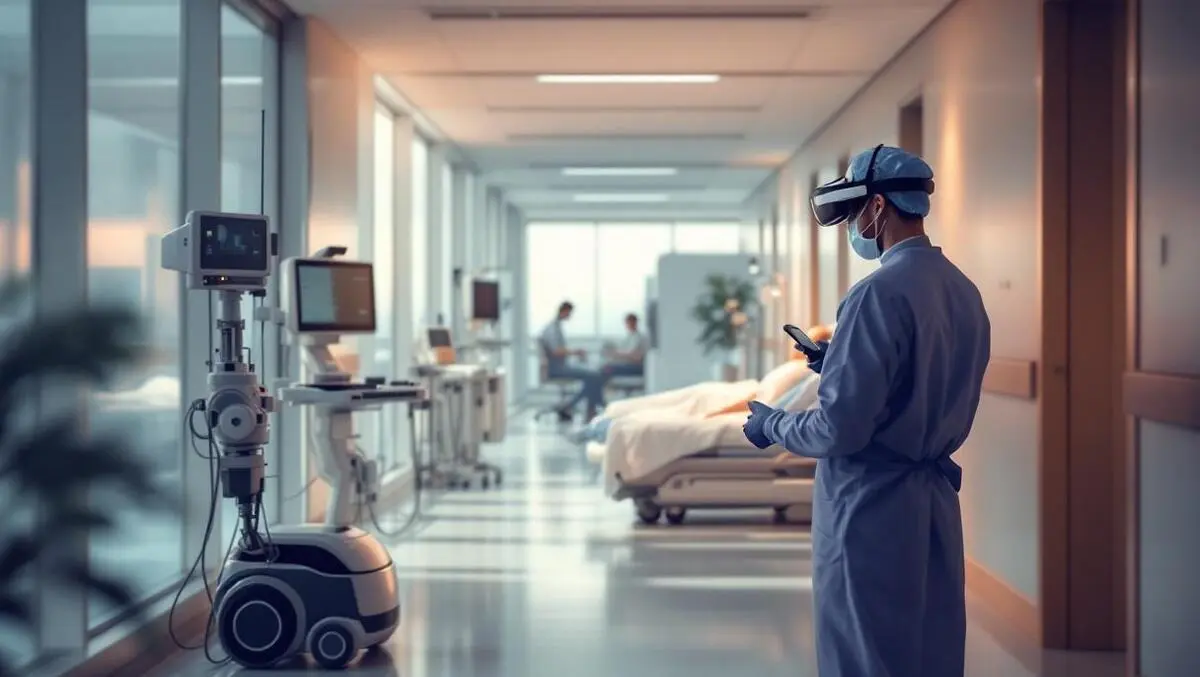
GSMA & NUHS team on 5G, AI to power smart hospitals
Thu, 26th Feb 2026
GSMA Foundry has struck a strategic agreement with Singapore's National University Health System (NUHS), linking mobile network technology with clinical and operational work in hospitals and community care.
The partnership brings together GSMA Foundry, the industry group's collaboration programme, and NUHS, an academic and regional health system. The organisations plan to develop use cases that combine 5G connectivity with AI-led tools and connected devices.
Singtel is involved as NUHS's connectivity partner and as a GSMA member. Ericsson is also participating, with the three organisations preparing demonstrations for MWC26 Barcelona.
Technology focus
The collaboration centres on advanced mobile networks in clinical settings, including private 5G networks, digital twin technology, extended reality (XR), internet of things devices and ambient AI.
Initial areas of work include remote surgical assistance over 5G, XR training and simulation for clinicians, robotic systems, and facilities management using connected sensors and AI software.
Healthcare providers have increasingly used mobile networks for applications that need stable connectivity across large campuses. Hospital environments also create complex requirements around device density, security, and separating critical traffic from less sensitive uses such as administrative systems.
Singtel is providing 5G standalone connectivity, secure virtual private networks and network slicing. These mechanisms support traffic separation and security controls, and allow different performance and reliability profiles across applications running on the same physical network infrastructure.
Adjunct Associate Professor Gao Yujia, Assistant Group Chief Technology Officer at NUHS, said the focus is on hospital operations and clinical workflows. "By harnessing advanced connectivity and innovative technologies such as ambient AI, XR and robotics, we are accelerating the development of truly intelligent hospitals. This integrated approach enhances clinical workflows and allows care teams to work more efficiently and effectively. I am passionate about how AI and connected systems can transform hospital operations - elevating precision, improving patient experience and empowering clinicians with the tools they need to deliver better outcomes across every stage of care," Gao said.
GSMA Foundry role
GSMA Foundry works with operators, vendors, startups and enterprises on technical trials and commercial experimentation. In healthcare, projects often span several domains, involving network providers, device manufacturers, cloud and AI platforms, and hospital IT and clinical governance teams.
Richard Cockle, Head of GSMA Foundry, described the agreement as a model for cross-sector collaboration. "Connected health is one of the most impactful frontiers for mobile technology. Our agreement with NUHS demonstrates how collaboration can accelerate innovation, delivering secure, scalable solutions that improve patient outcomes and operational efficiency. We are excited to start work at sites in Singapore with more early adopter centres to follow worldwide," Cockle said.
The agreement covers work at NUHS sites in Singapore, with plans to expand to other early adopter centres internationally. The parties have not disclosed commercial terms, investment levels or deployment timelines.
MWC demonstrations
NUHS will appear at the GSMA Pavilion at MWC26 Barcelona alongside Ericsson and Singtel. Planned demonstrations include a robot nurse companion and 3D holographic surgical planning using Microsoft's HoloLens 2.
The exhibition will also feature AI-driven augmented reality for vein detection and hospital-at-home technology. In these areas, reliable wireless coverage and device management can affect clinical usability, especially when services move between hospital sites and patients' homes.
Daniel Ode, Head of Ericsson Singapore, Philippines and Brunei, said the work builds on earlier deployments between the partners. "Ericsson is proud to be a core enabler of the connected health journey led in Singapore by NUHS. In partnership with Singtel, we have shown how differentiated connectivity, built on high-performance 5G and combined with AI and robotics technologies, have already delivered tangible patient and operational benefits over the past few years. We are excited to see these efforts now being showcased to a global audience, amplifying the impact of our joint work. This is a journey we are excited to continue - advancing secure, scalable healthcare solutions that extend care beyond hospitals into new contexts worldwide," Ode said.
Network approach
Mobile operators have promoted 5G standalone networks as better suited than earlier 5G deployments for industrial and public sector use cases. Standalone networks can offer tighter control of latency and quality of service, and support slicing as a native function.
Keith Leong, Chief Customer Officer, Enterprise, Singtel Singapore, said the operator has already worked with NUHS on several use cases.
"Singtel's advanced 5G standalone network, secure virtual private networks and network slicing capabilities are purpose-built to support the most demanding healthcare environments, delivering the ultra-reliable, low-latency and secure connectivity required for mission-critical applications. Working closely with NUHS, we have already demonstrated tangible outcomes - from enabling remote surgical support and immersive XR training to powering intelligent robotics and hospital-at-home models that improve patient experience and clinical efficiency. Through the GSMA Foundry, we are excited to scale these innovations and push the boundaries of connected health to accelerate the next wave of advancements towards 6G-enabled care," Leong said.
Gao will also take part in sessions at MWC26 Barcelona, including the Digital Health Summit and the Global Health Connector Summit at 4YFN, as the organisations outline the next phase of their joint work in Singapore and beyond.