

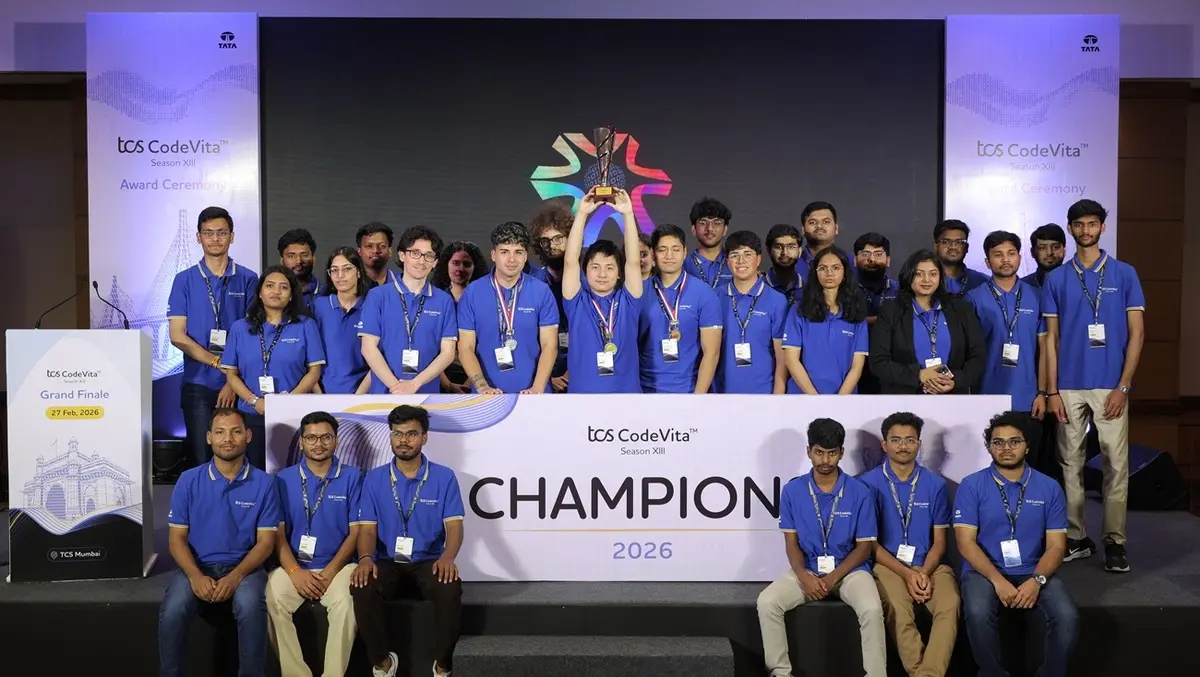
Chinese student wins world's largest coding contest
Sat, 28th Feb 2026
Tata Consultancy Services has named Zhou Jingkai, a 21-year-old from China, as the winner of its 2026 CodeVita global coding competition. The event also set a new Guinness World Records mark for participation.
Vincente Opazo from Chile finished as first runner-up, while Jorge Valdivia from Peru placed second. Organisers recorded 146,922 participants, which Guinness World Records recognised as the world's largest computer programming competition.
The figure surpassed CodeVita's previous record, set in 2021, extending the event's earlier Guinness title.
Swapnil Dangarikar, Senior Adjudicator at Guinness World Records, said the 13th season broke CodeVita's own record from season nine and supported TCS's aim of promoting programming as a sport and a force for positive change.
Talent pipeline
CodeVita is part of TCS's broader outreach to students and early-career developers. Open to college and university students worldwide, it uses a gamified model that frames programming as a competitive sport.
Sudeep Kunnumal, TCS Chief Human Resources Officer, said the record was a proud achievement and congratulated the winner and finalists. He described CodeVita as a way for aspiring coders to showcase real-world problem-solving skills and a channel for identifying high-potential talent as generative AI reshapes technology roles.
Over the years, hundreds of participants have secured roles at TCS, according to the company. Selected finalists also get the opportunity to intern with TCS Research and Innovation.
AI-assisted round
The 2026 season, CodeVita's 13th, included a new mini competition focused on AI-assisted programming. Thirty finalists took part in an event examining how people work with AI systems on complex programming problems.
Participants were provided with frontier AI models including ChatGPT, Claude Sonnet, and Gemini. TCS said it observed competitors using AI in different roles, including validator, collaborator, and outsourcing partner.
Alongside the overall winner and runners-up, the competition also recognised category winners among women coders, AI coders, and emerging coders.
In the Best Women Coders category, Tejaswini Singh from Lucknow won, with Keerthi KP from Chennai as first runner-up and Mahak Lachhwani from Bhopal as second. The Best AI Coder award went to Zhou Jingkai, with Benjamin Orellana from the United States as first runner-up and Jorge Valdivia as second. In the Best Emerging Coder category, Balashiva S from Chennai won, with Jose Nunez from Ecuador as first runner-up and Gabriella Padilla, also from Ecuador, as second.
Organisers also noted an increase in the number of Indian women reaching the final stage. Six Indian women finalists made the global top 30, which TCS described as the highest representation across all editions so far.
Competition format
CodeVita is an open-book contest, allowing participants to research and explore while solving problems. Competitors tackle questions of varying difficulty within a six-hour window, with each round introducing new real-world challenges that increase in complexity as the event progresses.
Historically, the final round has been limited to 25 contestants. This year, 30 competitors reached the final, representing eight foreign and 22 Indian participants, according to TCS.
Zhou Jingkai said he returned after being recognised in the previous year's competition.
"Winning TCS CodeVita feels surreal, especially since I almost tasted victory last year as the top Emerging Coder of the Year. Participating in the world's largest coding competition has been one of the most inspiring experiences for me. I returned to take part this year because it encourages us to sharpen our ability to break down complex challenges and think creatively under pressure. It provides a great opportunity to learn from fellow coders across the globe. I am grateful for this experience, which has not only strengthened my problem-solving capabilities but also inspired me to think differently," Zhou said.
TCS plans to continue running CodeVita as a global competition centred on competitive coding and student participation.