

Amogy to pilot ammonia cracking technology in Singapore
Wed, 4th Nov 2026 (Today)
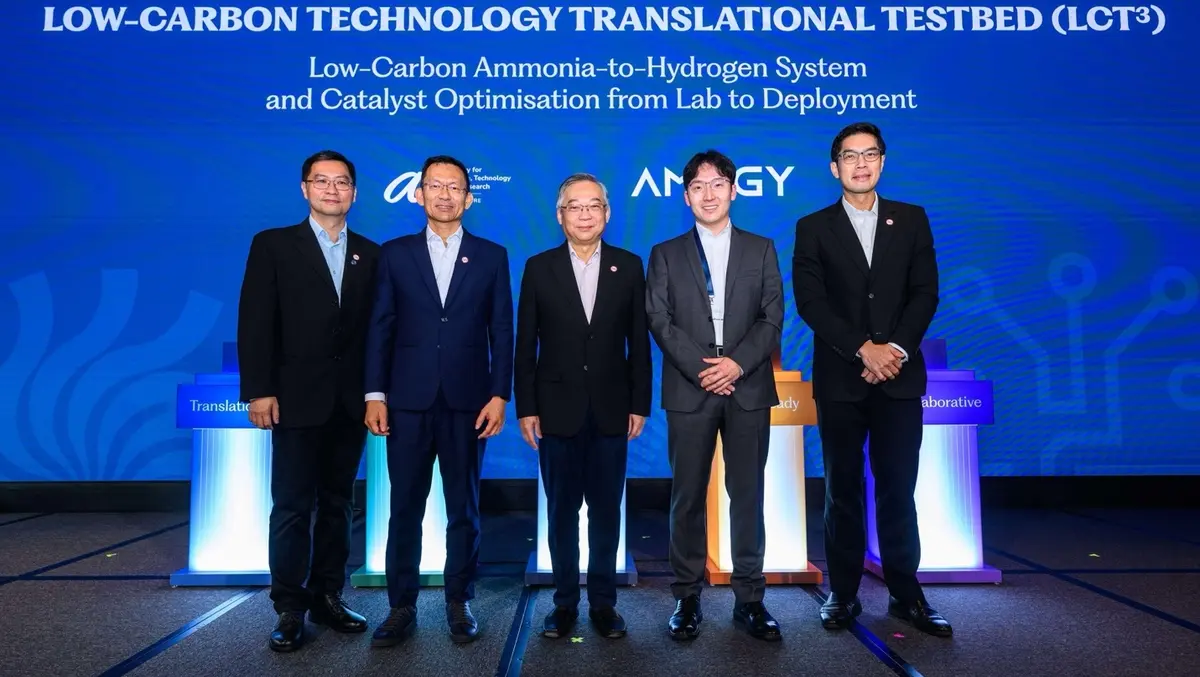
Amogy will pilot its ammonia cracking technology at the Low-Carbon Technology Translational Testbed on Jurong Island, in partnership with A*STAR and with support from the Singapore Economic Development Board. The project makes Amogy one of the first partners at the new facility.
Amogy plans to deploy its ammonia cracking module in 2027. The unit is designed to produce up to one tonne of hydrogen a day under industrial operating conditions, with the data intended to inform larger deployments of ammonia-based hydrogen and power systems in Singapore.
The testbed, known as LCT3, is hosted at the A*STAR Institute of Sustainability for Chemicals, Energy and Environment on Jurong Island. It is designed to bridge laboratory research and commercial use by giving companies a site to test low-carbon technologies at larger scale.
The agreement extends a partnership between Amogy and A*STAR announced in 2025. That earlier tie-up focused on lowering emissions in sectors including data centres and heavy industry, while this new phase gives the collaboration a defined pilot project.
Singapore plans
Beyond the pilot, the collaboration will cover research into lower-cost catalysts for ammonia-based hydrogen production. The Singapore work is also leading Amogy to establish its first research and development centre outside the US.
The move adds to the company's existing presence in Asia. Amogy is headquartered in New York and already operates in Singapore, Tokyo and Seoul, alongside its US sites.
Singapore's role in the project reflects the city-state's broader push to decarbonise industry on Jurong Island and assess alternative fuels for energy-intensive sectors. It also aligns with efforts to examine how low-carbon ammonia and hydrogen could support power supply for new data centre capacity.
Rules for Singapore's second data centre call for applications required at least 50% of proposed new capacity to be powered through eligible green energy pathways, including low-carbon ammonia and hydrogen. That has drawn attention to technologies that can convert imported fuels into usable low-carbon energy on site.
Amogy's system centres on cracking ammonia into hydrogen and nitrogen. In this pilot, the company will provide its reformer and catalyst technologies and oversee project execution, while A*STAR will support testing and joint development work.
Industrial testing
The emphasis of the Jurong Island deployment is not on a laboratory demonstration, but on operating the system under industrial conditions. That distinction matters for companies and policymakers assessing whether ammonia can serve as a practical hydrogen carrier for large energy users.
"Singapore is a strategic hub for Amogy's work across Asia-Pacific, where we are strengthening our core R&D capabilities and building our commercial presence," said Seonghoon Woo, Chief Executive Officer, Amogy. "Building on our multi-year collaboration with A*STAR and with the support of EDB, deploying our ammonia cracking module on Jurong Island is about putting our technology to work at a meaningful scale and laying the groundwork for broader commercial adoption across the region, including industrial hydrogen applications and data center power."
A*STAR said the pilot is intended to address a central issue facing newer low-carbon energy systems: proving they can work reliably beyond the research stage.
"For emerging low-carbon energy technologies, a critical challenge is demonstrating that they can perform reliably at scale and under industrial conditions. This is particularly relevant for technologies that use ammonia as a hydrogen carrier. Our collaboration with Amogy and real-world testing at LCT3 aims to bridge the gap between promising research and industrial adoption, building confidence in their potential for wider deployment," said Professor Lim Keng Hui, Assistant Chief Executive Officer, Science & Engineering Research Council, A*STAR.
Singapore's investment promotion agency cast the project as part of a broader strategy to attract companies that can use the country's research base as a route into regional markets.
"Amogy's collaboration with A*STAR demonstrates how companies can tap on Singapore's strong research capabilities to advance promising low carbon solutions towards industrial application. We welcome Amogy's plans to deepen its R&D presence in Singapore and use Singapore as a base to pursue growth opportunities across the region," said Mr Wey-Len Lim, Executive Vice President, Singapore Economic Development Board.